

Views: 0 Author: Site Editor Publish Time: 2026-10-30 Origin: Site


Extreme heat destroys modern electronics rapidly. Imagine a high-end LiDAR sensor on an autonomous vehicle failing during a blizzard because its internal laser overheated. Consider a 5G telecom tower shutting down in a summer heatwave. The demand for precise thermal management in today's high-tech landscape is accelerating at an unprecedented rate.
Thermoelectric coolers lead this thermal revolution. However, these Peltier modules undergo violent temperature fluctuations during operation. These rapid thermal shifts easily crack standard printed circuit board materials due to severe mechanical stress. To solve this engineering challenge, the industry relies on specialized inorganic substrates. The ceramic circuit board serves as the ultimate foundation for Peltier modules, offering unparalleled thermal conductivity and structural stability.
In this comprehensive guide, we explore the underlying physics of thermoelectric cooling. We will examine why specialized substrates are mandatory, evaluate the role of advanced metallization technologies, and break down the critical factors that guarantee long-term operational stability from a thermal engineering perspective.
Ceramic substrates are mandatory for Peltier modules. They provide exceptional thermal conductivity combined with robust electrical insulation, a dual requirement that standard polymer materials cannot meet.
Matching the coefficient of thermal expansion between the ceramic base and internal semiconductor materials prevents mechanical shearing during rapid temperature cycling.
Direct Plated Copper technology offers superior copper-to-ceramic adhesion. This enables high-density routing and significantly prolongs component lifespan.
Choosing between aluminum oxide and aluminum nitride requires a careful evaluation of the specific thermal load, power density, and budget of your application.
Proper thermal simulation and partnering with a qualified manufacturer are critical steps to prevent common failure modes like micro-cracking and solder joint fatigue.
Thermoelectric cooling represents a sophisticated solid-state method of thermal management. Unlike traditional compressor-based cooling systems, these modules utilize direct electrical current to transfer heat. To understand why specialized substrates are strictly required, it is necessary to examine the underlying physics and the severe limitations of conventional circuit boards.
Thermoelectric coolers operate on the principle of the Peltier effect. When direct current passes through a circuit consisting of alternating P-type and N-type semiconductor materials, typically bismuth telluride, heat is absorbed at one junction and released at the other. This creates a distinct temperature differential. One side of the module becomes freezing cold, while the opposite side becomes extremely hot.
The efficiency of this heat pumping mechanism relies entirely on how quickly the hot side can dissipate thermal energy into a heat sink. Any thermal bottleneck will cause the heat to flow back into the cold side. This neutralizes the cooling effect and can potentially melt the semiconductor pellets.
Standard printed circuit boards are typically manufactured from woven glass-reinforced epoxy resin, commonly known as FR4. These are entirely unsuitable for thermoelectric cooling applications. The primary limitation is their thermal resistance. FR4 has a thermal conductivity rating of approximately 0.25 to 0.3 W/m·K. It acts as a thermal insulator rather than a conductor. When subjected to the intense heat flux generated on the hot side of a Peltier module, FR4 traps the energy.
Consequently, the glass transition temperature of standard FR4 is relatively low. Continuous exposure to the high temperatures of a junction causes the epoxy resin to degrade, warp, or completely delaminate. The mechanical stress induced by the temperature differential easily tears the copper traces away from the substrate, leading to catastrophic electrical failure.
To overcome the thermal and mechanical limitations of polymer-based boards, engineers utilize inorganic ceramic materials. These specialized boards are engineered to handle extreme thermal environments while maintaining strict structural integrity under heavy clamping forces.
In a Peltier module, the substrate must perform two contradictory functions simultaneously. It must conduct heat perfectly while blocking electrical current entirely. Ceramic materials excel at this dual requirement. The ceramic layer acts as a highly efficient thermal bridge. It rapidly moves heat away from the sensitive semiconductor junctions and transfers it to an external cooling plate.
Simultaneously, its massive dielectric strength ensures that the electrical current driving the Peltier effect remains strictly confined to the copper circuitry. This prevents short circuits between the densely packed P-type and N-type pellets.
The manufacturing of ceramic circuit boards has evolved significantly to meet the miniaturization demands of modern electronics. Historically, Direct Bonded Copper was the standard. This involved bonding thick copper foils to the ceramic base using high-temperature oxidation. While effective for massive industrial chillers, this older method struggles with fine-pitch circuitry.
Today, the industry standard for high-precision thermal management is the DPC Ceramic Circuit Board for TEC. Direct Plated Copper utilizes vacuum sputtering to deposit a thin seed layer of metal onto the ceramic, followed by electroplating to build up the copper thickness. This process allows for precise circuit etching, excellent flatness, and superior metallization adhesion. It is the ideal solution for micro-coolers used in modern telecommunications and optical sensors.
While the manufacturing process dictates precision, the raw material itself governs fundamental thermal capabilities. The reliability of a cooling module is heavily dependent on the specific type of ceramic used. Field engineers must choose between aluminum oxide and aluminum nitride based on actual power density requirements.
Aluminum oxide, specifically 96% purity, serves as the baseline standard for the vast majority of commercial thermoelectric coolers. It offers a respectable thermal conductivity ranging from 24 to 28 W/m·K. This is nearly 100 times greater than standard FR4. It boasts excellent mechanical strength, high electrical insulation, and robust resistance to chemical degradation. For applications with copper thickness requirements around 10μm to 130μm and moderate heat flux, this remains the most cost-effective, high-yield solution.
For heavy-duty, high-power-density applications, aluminum nitride is the undisputed material of choice. It provides an extraordinary thermal conductivity of 170 to 230 W/m·K, which is roughly seven to ten times that of standard alumina. This massive thermal transfer capability makes it indispensable for applications generating intense heat in very small footprints.
From a structural standpoint, its coefficient of thermal expansion is even closer to silicon. While the raw material and processing costs are significantly higher, its use is mandatory in advanced optical communications and high-power laser systems where thermal bottlenecks cannot be tolerated.
| Property / Material | FR4 Reference | Aluminum Oxide 96% | Aluminum Nitride |
|---|---|---|---|
| Thermal Conductivity | ~0.3 W/m·K | 24 - 28 W/m·K | 170 - 230 W/m·K |
| Thermal Expansion | 14 - 17 ppm/°C | 7.0 - 8.0 ppm/°C | 4.5 - 5.0 ppm/°C |
| Dielectric Strength | ~20 kV/mm | >15 kV/mm | >15 kV/mm |
| Relative Cost | Very Low | Moderate | High |
| Engineering Fit | Low-power electronics | General-purpose coolers | High-power, compact modules |
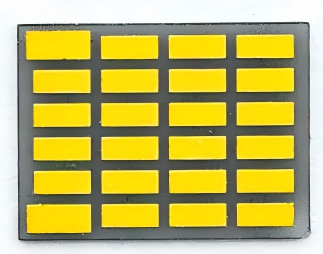
The long-term operational stability of a thermoelectric cooler is never accidental. It is the direct result of precise material science and engineering. Five core physical properties dictate why ceramic boards survive under conditions that obliterate other substrates.
The primary metric of a cooler's efficiency is its maximum temperature difference. To achieve and maintain this cooling state, the substrate on the hot side must dissipate heat instantly. Ceramic boards provide a low thermal resistance pathway. By minimizing the thermal impedance between the semiconductor pellets and the external heat sink, the ceramic board prevents thermal saturation. This ensures the module operates at peak efficiency without baking the internal junctions.
Thermal cycling inherently induces mechanical stress. As materials heat up, they expand. As they cool, they contract. If the substrate expands at a significantly different rate than the bismuth telluride semiconductor pellets mounted on it, the resulting shear stress will literally tear the solder joints apart.
Ceramic materials possess a naturally low expansion rate that closely aligns with these semiconductor components. This matching is the single most vital factor in preventing mechanical failure during the rapid, repetitive temperature fluctuations inherent in operation.
Peltier modules are typically installed under significant clamping pressure. This ensures optimal physical contact with heat sinks and cold plates. Any bowing, warping, or flexing of the substrate under this pressure will create microscopic air gaps. Air acts as a thermal wall, killing efficiency. Ceramic boards possess exceptionally high flexural strength and rigidity. They maintain near-perfect flatness even under high mechanical loads and extreme temperatures, ensuring uniform thermal contact across the entire module surface.
A cooler operates by passing a high current at low voltage through dozens of semiconductor pairs arranged electrically in series and thermally in parallel. The substrate must isolate these electrical paths flawlessly. Ceramics are inherent insulators with high dielectric strength. They prevent current leakage and electrical shorts, even when the module is operating at maximum power. Unlike polymer-based dielectrics, this electrical stability does not degrade over years of continuous thermal stress.
Looking at the broader landscape, the demand for advanced thermal substrates is being aggressively driven by converging macro-trends. In the realm of AI data centers and telecommunications, the transition to 800G and 1.6T optical transceivers has pushed silicon photonics to their absolute thermal limits. These high-speed modules generate immense heat in incredibly small form factors. Passive cooling is no longer viable. Active, localized thermoelectric cooling is required to maintain wavelength stability.
Furthermore, the automotive sector's push towards autonomous driving relies heavily on LiDAR arrays. These systems must operate flawlessly in extreme ambient temperatures, from freezing winters to scorching desert summers. This industry-wide shift towards higher power densities means that thermal management is the primary bottleneck in hardware design. As a result, the adoption of advanced TEC ceramic substrates, particularly aluminum nitride paired with thin-film technology, is transitioning from a niche aerospace requirement to a mainstream commercial necessity.
While the ceramic base material provides the foundation, the method used to attach the copper circuitry to the ceramic is equally critical. When evaluating long-term performance, integrating Direct Plated Copper solves several engineering challenges associated with older metallization techniques.
In this modern process, the ceramic substrate is placed in a vacuum chamber. A thin titanium or chromium adhesion layer is sputtered directly onto the bare ceramic, followed by a copper seed layer. This physical vapor deposition creates an atomic-level bond between the ceramic and the metal. The result is an exceptionally high peel strength. Under severe thermal shock testing, such as rapid cycling from -40°C to +125°C, the copper traces will not delaminate. The electrical circuit remains intact throughout the module's lifespan.
Traditional processes require aggressive chemical etching of thick copper foils. This results in a trapezoidal trace profile and limits how closely traces can be placed together. In contrast, modern sputtering and electroplating utilize semiconductor-grade photolithography. This allows for highly vertical trace sidewalls and ultra-fine line resolution down to 50 micrometers. Such precision enables the design of highly miniaturized Peltier modules required for compact optical transceivers and wearable medical devices.
In older manufacturing processes, microscopic air voids could sometimes form between the copper layer and the ceramic base. These voids act as localized thermal bottlenecks, causing specific semiconductor pellets to overheat and fail prematurely. The vacuum sputtering and electroplating processes are inherently void-free, typically achieving a void rate of less than 1%. This guarantees a uniform thermal interface across the entire surface of the board, allowing for predictable and reliable heat transfer.
Engineers specify ceramic substrates primarily as a defensive measure against known failure mechanisms. Understanding how these coolers typically fail highlights the absolute necessity of these advanced materials.
The most prevalent failure mode is solder joint fatigue. As the module powers on and off, the hot and cold sides expand and contract. If a standard board or a mismatched metal-core board is used, the differential expansion creates shear forces that cause micro-cracks in the solder joints. Over time, these cracks propagate, increasing electrical resistance until the circuit breaks completely. The matched thermal expansion of a ceramic substrate minimizes this shear stress, extending the thermal cycling life of the solder joints from a few thousand cycles to potentially millions.
Thermal shock can cause brittle materials to crack. If a substrate lacks sufficient thermal conductivity, localized hotspots form. This creates internal thermal gradients that stress the material beyond its tensile limit. High-grade ceramics are engineered and sintered to distribute heat rapidly, preventing extreme localized gradients. Their high mechanical fracture toughness ensures that the substrate can absorb rapid thermal shocks without developing micro-cracks.
The unique properties of ceramic-based Peltier modules make them indispensable across several high-technology sectors where precise temperature control is non-negotiable.
In fiber optic networks, laser diodes must be maintained at a very specific temperature, often within ±0.1°C, to ensure the stability of the emitted wavelength. If the temperature drifts, the data transmission suffers from signal degradation or complete loss. Micro-coolers built on aluminum nitride substrates are integrated directly into transceiver packages to actively cool the lasers, handling high heat fluxes in extremely confined spaces.
The automotive industry relies heavily on thermal management for critical sensor accuracy. Autonomous driving systems utilize LiDAR, which contains sensitive laser arrays and photodetectors that require thermal stabilization. To survive the continuous vibration, moisture, and temperature extremes found in automotive applications, engineers depend on highly reliable TEC boards made from rigid ceramics.
Medical devices demand zero-failure reliability. Polymerase Chain Reaction machines, used for DNA amplification, require rapid and precise thermal cycling. They often heat and cool liquid samples dozens of times in a single hour. To endure this, engineers specify advanced ceramic boards to provide the exact temperature ramp rates required for these biological reactions without degrading under continuous cyclic stress.
The theoretical advantages of ceramic materials are only realized if the board is manufactured to exacting standards. Selecting a qualified fabrication partner is a critical engineering decision. When evaluating providers, several core competencies must be verified.
First, verify their advanced manufacturing capabilities. Ensure the supplier possesses in-house vacuum sputtering and electroplating lines capable of achieving 50μm line spacing and void-free copper adhesion. Second, demand strict quality control. A reliable manufacturer will implement rigorous protocols, including thermal shock testing and scanning acoustic microscopy to guarantee structural integrity.
Finally, look for front-end engineering support. Off-the-shelf solutions rarely optimize the performance of a custom module. Partnering with an experienced fabricator ensures you receive Design for Manufacturability feedback, optimizing layout for better thermal spreading and higher production yields.
The reliability of any thermoelectric cooling system fundamentally relies on the quality and physical properties of its substrate. As electronics continue to shrink while power densities rise, traditional materials are no longer viable for active thermal management. Ceramic boards offer the perfect balance of exceptional thermal conductivity, unmatched electrical insulation, and structural stability.
By leveraging matched thermal expansion to prevent mechanical failures and utilizing vacuum-sputtered copper technology for superior metallization adhesion, engineers can design Peltier modules that endure hundreds of thousands of thermal cycles. If you are developing a high-performance cooling solution and need to eliminate thermal bottlenecks, it is time to upgrade your substrate. Visit https://www.xrmkpcb.com to explore custom DPC ceramic circuit boards, discuss your specific thermal management requirements with our engineering team, and request a quote for your next project.
While metal-core boards are excellent for basic heat dissipation in devices like high-power LEDs, they rely on a dielectric polymer layer to separate the copper circuit from the aluminum core. This polymer layer inherently possesses high thermal resistance. For the extreme thermal cycling, rapid heat flux, and sub-zero temperatures of Peltier modules, only pure ceramic provides the necessary thermal conductivity and expansion matching without degrading over time.
When designed correctly using advanced thin-film technology and matched expansion materials, a high-quality ceramic board is exceptionally durable. It will often outlast the actual semiconductor components of the module itself, enduring hundreds of thousands of thermal cycles over many years of continuous operation without suffering from copper delamination or thermal fatigue.
Not necessarily. While aluminum nitride offers vastly superior thermal conductivity, up to 230 W/m·K, it is significantly more expensive to manufacture and process. Aluminum oxide, at roughly 24 W/m·K, is highly reliable and perfectly adequate for the vast majority of low-to-medium power modules. Aluminum nitride is typically reserved for high-power, high-density applications where maximum heat flux is strictly required to prevent catastrophic overheating.
When two bonded materials have different expansion rates, heating and cooling cause them to grow and shrink at different speeds. In a cooling module, if the substrate expands faster than the semiconductor pellets, it creates immense shear stress on the solder joints connecting them. Over repeated cycles, this stress causes the solder to crack, increasing electrical resistance and eventually causing a complete open circuit.
Bare ceramic substrates like alumina and aluminum nitride can withstand temperatures well over 1000°C. However, in practical applications, the maximum operating temperature is limited by the metallization layer and the solders used for component assembly. Most high-quality direct plated copper ceramic boards are rated to operate reliably in environments up to 250°C to 300°C, making them more than capable of handling the hottest junctions in commercial and aerospace thermal management systems.


