

Views: 240 Author: Site Editor Publish Time: 2026-05-27 Origin: Site


The relentless shift from 2D planar arrays to stacked die architectures fundamentally breaks the capabilities of traditional organic materials. Standard FR-4 and polymer substrates simply fail under the extreme heat flux and mechanical stress of modern designs. They warp, blister, and degrade rapidly.
As industries push toward EV 800V platforms and 5G/6G RF modules, engineers must pivot. A 3D Ceramic Packaging Substrate becomes the mandatory choice. It guarantees survival in high-power, high-frequency, and high-reliability environments.
This article moves beyond generic material lists. We will provide a strict technical evaluation of advanced ceramic options. You will learn about precise manufacturing constraints. We will also show you how to perfectly align these substrates with your specific project parameters.
Thermal vs. Electrical Trade-offs: Substrate choice is a strict balancing act; high-thermal-conductivity materials often restrict the use of highly conductive metals due to manufacturing temperatures.
Silicon Match is Critical: Advanced ceramics (like AlN) offer a Coefficient of Thermal Expansion (CTE) that closely matches Silicon (~2.6–3.5 ppm/°C), preventing delamination in dense 3D IC packaging.
The Rise of Glass-Ceramics: For high-frequency (5G/6G) applications, glass-ceramics (via LTCC) are overriding traditional alumina due to ultra-low dielectric loss (tan δ < 10^-3).
In modern architecture, stacking dies vertically exponentially increases power density. It drastically reduces the available footprint for thermal dissipation. The module generates massive, concentrated heat. Traditional printed circuit boards cannot remove this heat fast enough. This physical limitation dictates a transition to advanced inorganic materials.
To succeed, a modern substrate must meet three strict criteria:
Thermal Management: The material must passively dissipate heat. Relying on massive active cooling overhead is inefficient. We require high intrinsic thermal conductivity to move heat away from delicate logic cores rapidly.
Mechanical Stability & CTE Matching: Mismatched expansion rates cause severe damage. In fact, they account for over 50% of premature module failures in power electronics. The substrate must expand and contract at the exact same rate as the silicon die. This prevents thermal fatigue from shearing solder bumps.
Signal Integrity: High-density routing demands clean, unimpeded signals. The substrate must maintain a low dielectric constant (εr). It must also offer minimal dielectric loss. This prevents critical signal degradation across dense vertical interconnects.
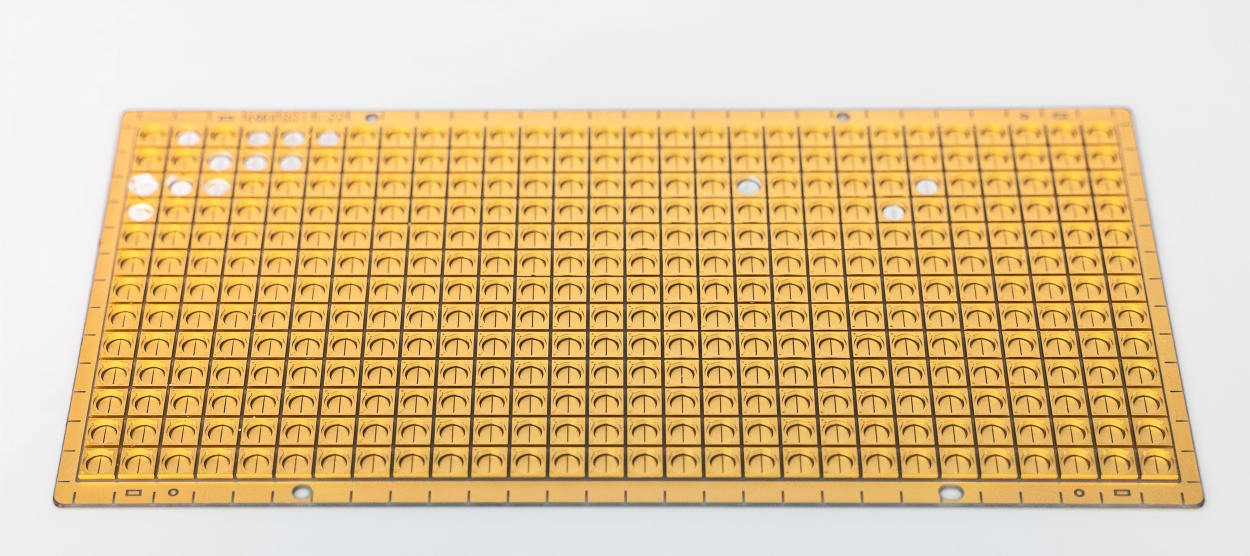
Engineers must evaluate standard industrial options based strictly on data-driven trade-offs. There is no universally perfect material. Every formulation serves a specific thermal or mechanical niche.
Alumina dominates the legacy market. It is highly mature. It offers excellent electrical insulation. It remains highly cost-effective for standard applications. Manufacturers easily source and process it.
However, it features moderate thermal conductivity. Typical values range between 20-30 W/m·K. It proves totally inadequate for extreme high-power density modules. Relying on alumina for next-generation power stacks invites catastrophic thermal runaway.
AlN provides exceptional thermal conductivity. It easily reaches 170–230 W/m·K. Crucially, it delivers a near-perfect CTE match with bare Silicon. This prevents dangerous mechanical sheer stresses during operational thermal cycling.
It stands as the default engineering choice for demanding sectors. You will find it in high-power LEDs and dense compute modules. EV traction inverters heavily rely on this specific formulation. It remains the gold standard for premium thermal management.
Si3N4 has lower thermal conductivity than AlN. It usually hits around 90-120 W/m·K. However, it possesses superior fracture toughness. Its flexural strength is unmatched in the ceramic category.
It shines in harsh physical environments. Automotive active safety systems rely on it heavily. Severe temperature cycling would crack rigid AlN substrates. Si3N4 survives these rigorous mechanical shocks easily. It bends slightly without shattering.
SiC offers broad wide-bandgap compatibility. It boasts ultra-high thermal conductivity ranging from 100 to 400 W/m·K. It handles extreme ambient temperatures flawlessly. This makes it highly desirable for next-generation aerospace components.
The major risk factor is machinability. SiC is extremely hard to cut or laser-drill. This hardness drives up manufacturing costs significantly. It heavily restricts complex 3D shape availability. You cannot easily form intricate cavities using pure SiC.
| Material Type | Thermal Conductivity (W/m·K) | CTE Match with Silicon | Primary Engineering Strength |
|---|---|---|---|
| Alumina (Al2O3) | 20 - 30 | Poor to Moderate | Cost-efficiency, mature processing |
| Aluminum Nitride (AlN) | 170 - 230 | Excellent (~4.5 ppm/°C) | Peak thermal dissipation |
| Silicon Nitride (Si3N4) | 90 - 120 | Good | Extreme fracture toughness |
| Silicon Carbide (SiC) | 100 - 400 | Good | Wide-bandgap compatibility |
High-frequency telecommunications require specialized material profiles. We must separate true glass-ceramics from basic physical composites. True glass-ceramics undergo controlled in-situ crystallization. Manufacturers apply precise heat treatments to grow ceramic crystals natively inside a glass matrix. Physical composites merely mix glass frit and ceramic powder before firing.
Standard ceramics often fail in mmWave and 6G applications. High frequencies demand extreme signal clarity. Frequencies above 30 GHz suffer massive attenuation in standard materials. Glass-ceramics allow deep customization of the dielectric constant. Engineers can push εr comfortably below 4. They also achieve ultra-low dielectric loss. This prevents signal drop-off.
These materials offer incredible form factor advantages. They are highly suitable for complex internal integration. You can embed passive components directly inside the cavity structure. Inductors and capacitors fit natively within the intermediate routing layers. This heavily supports compact 3D IC packaging architectures. It eliminates the need for bulky surface-mounted components.
Raw material specs mean nothing if factories cannot manufacture them properly. Decision-stage readers must align their material choice with electrical routing realities. The firing process fundamentally limits your choice of conductive trace metals.
Factories fire HTCC layers at roughly 1600°C. They typically use Alumina or pure AlN for this process. The resulting monolithic structure is incredibly dense.
This yields extreme mechanical and thermal stability. However, the extreme heat demands refractory metals for electrical routing. You must use Tungsten or Molybdenum. These metals suffer from significantly higher electrical resistance. This elevated resistance makes HTCC poor for high-speed, high-frequency signal transmission.
LTCC uses advanced glass-ceramics. Engineers fire them at a much lower 850–900°C. This lower temperature window changes the entire engineering paradigm.
The lower sintering temperature allows co-firing with highly conductive metals. You can route lines using Gold, Silver, or Copper. It provides excellent spatial routing density. It secures perfect signal integrity for a complex 3D Ceramic Packaging Substrate. The major sacrifice is peak thermal conductivity, often falling to just 2–7 W/m·K.
Best Practice: Always match your metallization requirements with your total thermal budget during the early prototyping phase. This prevents late-stage redesigns.
Common Mistake: Over-specifying thermal conductivity. Many engineers demand AlN when the actual thermal bottleneck lies in the die-attach paste. This wastes engineering budget unnecessarily.
You need a rigid methodology to choose the correct material. Avoid relying on vendor marketing alone. Use this three-dimensional evaluation framework to guide your final specification.
Dimension 1: Power vs. Heat (The Thermal Path). Analyze your expected heat flux. If your thermal load requires dissipation greater than 100 W/m·K, shortlist AlN or Si3N4 immediately. Alumina will likely fail.
Dimension 2: Signal Speed vs. Resistance (The Electrical Path). Determine your primary operational frequency. If RF or high-frequency signaling dominates the requirement, shortlist Glass-Ceramics. Utilize the LTCC process to access copper routing.
Dimension 3: Environmental Stress vs. Lifespan (The Mechanical Path). Evaluate the physical deployment environment. If you expect high mechanical shock, intense vibration, or extreme thermal cycling, bias your choice toward Si3N4. Combine it with Active Metal Brazing (AMB) processing for maximum structural durability.
Consider scalability and core manufacturing constraints. Alumina remains the baseline standard for a reason. Do not over-engineer your module. Only move away from Alumina if specific limits of thermal stress mathematically justify the upgrade. The premium pricing of AlN or LTCC setups requires solid technical justification.
Material selection for a 3D ceramic packaging substrate is never a single-variable decision. It represents a strict intersection of physical constraints. You must carefully balance absolute thermal dissipation, silicon CTE matching, and co-firing metal compatibility. Ignoring any single variable leads to premature module failure.
We strongly encourage engineering teams to run comprehensive early-stage thermal simulations. Utilize advanced EDA tools before committing to any physical substrate material. Validate your heat flux models early. Verify your high-frequency signal paths through digital twin software.
Do you need precise guidance for your next major project? We invite you to submit your packaging schematics and thermal constraints to our engineering team. We will provide a comprehensive technical feasibility review and targeted material recommendations.
A: BeO possesses excellent intrinsic thermal properties. However, it presents severe toxicity risks. Machining BeO creates microscopic dust. Inhaling this dust causes Berylliosis, a chronic and incurable lung disease. This triggers strict regulatory compliance burdens globally. Consequently, the electronics industry has largely replaced it with Aluminum Nitride (AlN). AlN offers highly comparable thermal performance without the hazardous environmental and human health risks.
A: Direct Bonded Copper (DBC) bonds copper directly to ceramics at very high temperatures. It is cost-effective but struggles under extreme mechanical stress. Active Metal Brazing (AMB) uses a specialized active metal alloy. This alloy brazes copper onto the rigid substrate. AMB provides significantly higher reliability. When paired with Si3N4, it delivers exceptional peel strength during harsh thermal cycling.
A: Yes. Advanced ceramics are highly chemically inert. They do not naturally degrade over time like traditional organic PCBs. While their initial manufacturing requires intensive energy, their extended operational lifespan improves overall lifecycle sustainability. Furthermore, specialized industrial recycling facilities can reclaim the precious trace metals. They can often repurpose the underlying base ceramic materials for secondary industrial abrasives.


